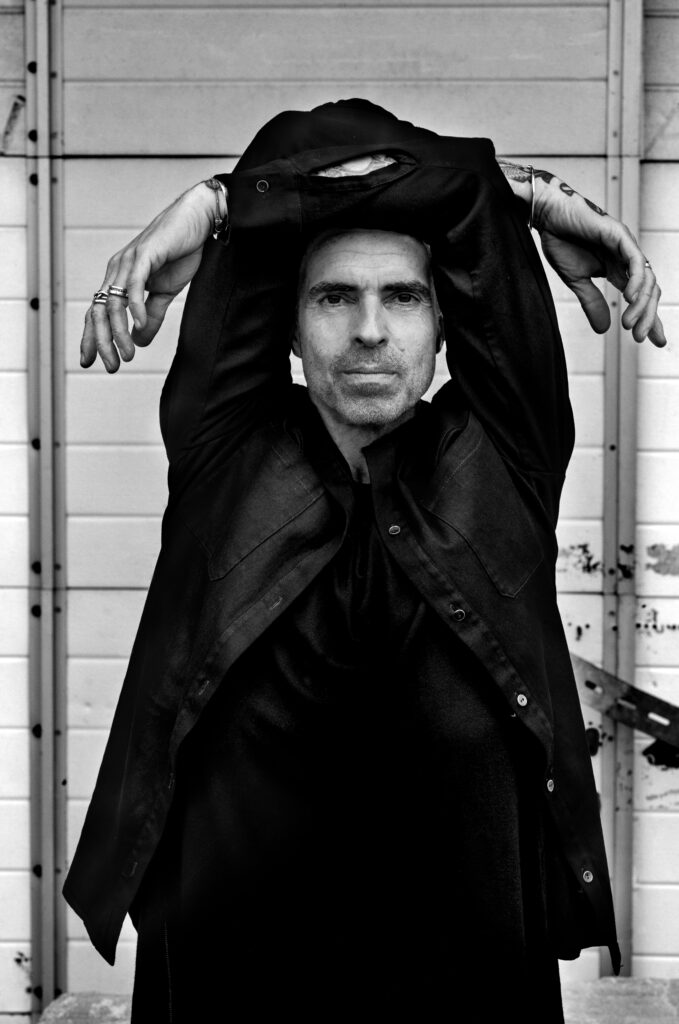
In this conversation, we reconnect with Chris Liebing as he enters a new chapter with Evolver and a packed year ahead. From Depeche Mode influences to mastering in LA and navigating techno’s shifting landscape, he reflects on the past, present, and what comes next.
Dirty Epic: The CLR label has been strong with a steady stream of releases, seemingly every month of 2025. What are your goals for CLR in 2026?
Chris Liebing: I want to support the amazing artists on the label and keep my ears open for new, exciting techno producers. There’s a lot of great music out there at the moment. Most of the first half of this year is dedicated to my album, its EP and remix releases.
But apart from that, I have already signed some absolutely mind-blowing tracks by Risa Taniguchi, Shlomi Aber and DJ Dextro, amongst other great upcoming releases. The label has been a lot of fun lately, and we will continue to have loads of fun this year.
DE: Also, your tour schedule was rock solid this past year and doesn’t show signs of slowing. How do you balance running the label and podcast while recovering from jet lag, and still find the time to write music?
CL: Everything simply takes a little longer. You have to be patient. I am having as much fun as ever, if not more. It is such an incredible experience to combine old school stuff with more modern-sounding music. I think the possibilities and tools we currently have at hand only get better, enabling us to create something truly unique and suited to the moment. And fun is definitely a big part of it. Having fun along the way is essential for maintaining balance.
And apart from that, a few years ago I decided to live in the mountains, so I get to be outside a lot in the winter and in the summer. And that also inspires me to make music. I built myself a nice little studio here, and it’s a cozy place where I really enjoy experimenting after a day out in nature.
DE: So your Evolver album is coming this March. Looking at all the titles, one might surmise that this LP is very LA and Sci-Fi coded. For example, The Terminator is set in LA, and Blade Runner is set in some distant alternate reality Los Angeles, and even the mastering is done in LA. Why here? What was the choice for that?
CL: You forgot that Brooks Avenue is also in LA. I have always had a very strong connection to Los Angeles. Even as a kid growing up in Germany, I was heavily influenced by television series from Los Angeles. Something somehow always makes me feel very much at home there, especially when I am in Venice. But most of all, I have found some amazing friends there over the years, some of my best friends in the music world and in my life, like for example Moe (Drumcell) and David (Truncate). I think we share a very similar musical vision, and we just love to hang out and have a good time together.
So LA has always been a very dear place to me. It actually wasn’t planned that I ended up doing the final mastering of the album in LA. I just happened to be there when I had to deliver the final masters, so there wasn’t really much choice. Thanks to Drumcell, I got access to a really beautiful studio, and it all worked out amazingly well.
DE: There seems to be a lot of Depeche Mode references on the release itself. If anyone knows something about you, it’s that you’re a big Depeche Mode fan. One for Mute and Daniel Miller being involved, and also the Anton Corbijn photography seems certainly like a nod to Dave Gahan and Martin Gore’s 2023 Tour photo in LA. Can you describe the thought process behind this, or was it an homage out of respect for your friends and peers?
CL: To assume that I have a complex thought process or a proper plan behind what I do would be a bit of an overstatement. I have always been a huge fan of Mute Records since I discovered music. Only later on, I found out that Depeche Mode was actually a band on that label. Many, many years later, in 2003, I met Daniel Miller for the first time, just around the time I released my album “Evolution”. Over the years, I have become very close to the Mute Records label team and to Daniel. We have played many back-to-back sets together. Daniel is an amazing DJ, and one can learn a lot from him in basically any aspect of life. He’s an incredible human being, and he’s given us a vast amount of great music and helped so many artists accomplish so much. It’s a huge, huge honour to have him as a collaborator on my album.
And of course, I not only love the music of, for example, Depeche Mode, I also love their whole artwork, their videos and everything around them. And at some point, I found out about the man behind all that, the person behind all that art, the visuals, the videos, the cover artworks and the photographs. More and more, I learned about Anton Corbijn.
Making an album really means a lot to me, because it is a format I have always liked very much, and it is perfect for trying to get a broader point across that you can’t really do with a club track. I wouldn’t say it’s a proper concept album, but it is something you could possibly listen to from start to finish. I always enjoyed that about albums and that they were able to tell a story, which I tried to do with this one.
When we started discussing the artwork and new photos, my manager, Roland, came up with the (for me at that point totally crazy) idea to ask Anton Corbijn to take the pictures. Somehow, he managed to pull that off, together with the big help of Mute Records. It’s an incredible honor to be photographed by that man. And it was an amazing experience to get to know him even better through his work. But if there is a nod to Dave Gahan and Martin Gore´s 2023 tour photo, which was not even remotely the plan, I do believe that possible similarities are due to Anton’s style. I would not dare to try to imitate anything like this. So yeah, I think all the music I do is heavily influenced by my upbringing. My musical upbringing is heavily influenced by Mute Records, and I think that everything I am doing is very much inspired by this label and its artists.
DE: How does collaboration on the album actually work—are you trading stems for remixes and reworks, building on each other’s initial ideas, or working together in the studio?
CL: It works in all sorts of varieties, everything you have mentioned above in your question and more. I would say all the collaborations on my album were approached very differently, and only one was done with the other artist in the studio. What all the remixes have in common is that I kind of finalized them in my studio, evidently with the collaborating artist’s agreement. The collaboration process varied significantly from one project to another.
In one case, we were sending almost full tracks back and forth, then picking out the best parts to morph into one track. Another one was just an intro idea that, somehow, without any planning, turned into a track through constant back-and-forth on stems. And that was the beauty of it. There were no rules for how a collaboration would have to work; that´s why each one of them turned out very individual and unique.
DE: Techno albums are rare, and the line between an EP and an LP in this genre is often blurred. What makes this project feel like a true album for you rather than just a collection of tracks?
CL: That was kind of the challenge I faced, but I hope I accomplished it. To essentially make a techno album of which you can play the majority of tracks in a techno night, yet somehow doing it in a way that in itself tells a story and connects with the other tracks, following a larger arc… Maybe I shouldn’t really call it “telling a story”, that may go too far, but there is a beginning, a centre and an end to this album, with ups and downs and breaks.
And I was also very focused on making it work so that I could be listened to from the very beginning to the very end. It is 1 hour and 5 minutes long, contains 13 tracks, and keeps a good pace, the way I felt it as a DJ. That’s what I always loved about albums: being able to put them on and just trust that the artist made the right decision about the track order, and to discover the music through an overarching story, if you want to call it that.
DE: It seems like you may have had many opportunities to release your first album, but why has it taken until 2026 to make this decision?
CL: I think I wasn’t ready before. I always had incredible help producing music. My first collaborator in the studio was Andrew Wooden (aka André Walter), and we did all the Stigmata series and all the early CLR releases together. We also did house tracks together, and even had a release on Strictly Rhythm in 1996. In 2003, I recorded my first album with him, titled “Evolution”. From 2004 onward, I built my own studio and began producing way more on my own. But for my follow-up albums released on Mute Records, I really wanted to work with Ralf Hildenbeutel, because he is such an incredible musician and studio engineer. Apart from that, he’s an incredible human being, and it’s so much fun to work with him on music. It’s not really techno music you would play at peak time in a club, but more of a listening experience.
So I always had this idea of a proper techno album in the back of my head. I just had to do it at some point. I have done a lot of 12 inches here and there over the past 15-20 years, and I kept thinking that I want to do an album, which really represents and sums up the techno that I come from. And my idea was to do it on my own, to see if that was even possible. I had no idea, and you’ll be the judge if it turned out somewhat entertaining!
DE: The Roy Batty EP felt like it pointed to something larger. Roy Batty — the replicant from Blade Runner — wrestles with mortality and the unknown. Do you ever feel that kind of anxiety about what comes next, and how does it show up for you?
CL: My first idea for the album was actually to make it all about AI and its dangers, above all, the danger of AI becoming sentient. So Roy Batty and John Connor were tracks that I made for the album in the very beginning of the process. But then I started to think a little bit more outside that box and felt like it’s probably just a part of our evolution, which – no pun intended – is the name of my first album. I asked myself “Towards what kind of existence are we evolving?” “Are we all just steppingstones to machines” like Arthur C. Clarke already said a long time ago? By the way, there are samples of his voice in the track “Higher Things”. So I was rather asking myself the question “how will we evolve?” and that’s when I stepped a little bit away from the exclusive AI idea towards a broader “where do we come from, where do we go to” kind of idea.
Musically, it’s pretty clear where I come from, and this is also what I wanted to manifest and represent on this album. I wanted to recreate the kind of techno I grew up with, maybe just a little more modern-sounding. And yes, sometimes I feel that anxiety about what’s coming, but for some reason, I kind of have this huge portion of trust and faith in this universe. I believe we are here to explore and experience something, and that, in the end, everything should make sense. Maybe also this interview!
DE: There is certainly some uncertainty in techno, with the threat of AI coming on the horizon, and one of your favorite music platforms, Native Instruments, is currently restructuring. As someone who has seen a lot of changes in the scene, how are you personally looking to mitigate or react to these changes?
CL: Well, change is inevitable. And it’s not just good changes happening. I am really sad to see what happens with Native Instruments, but we will see how it turns out. In the end, I just wish all the people who are working there well. I hope that nobody will lose their job and that the company can somehow continue. AI is definitely not going to change only our music industry. It’s going to change the whole world sooner or later, maybe a little bit later than we all thought. Maybe we still have a little bit more time before AI completely takes over. Who knows all of this? In a way, those are ideas I am also dealing with on the album, and I think I just kind of accept and flow with it.
When it comes to AI in music, I really enjoy the process of making music. If there’s something that could be helpful, like maybe an AI plugin that shows you settings you wouldn’t have thought of, fine, but ultimately I want to be the person who creates and makes the decisions, using tools that enable me to do so. As long as I am having fun with what I am doing and know that what I am creating mostly comes from me, not from some sort of computer, I will surely enjoy the ride of producing new music. Anyways, AI will change a lot of things, and maybe that should also teach us to better enjoy this moment and have a good time, because change is simply inevitable.
DE: Your career has always balanced precision and intuition, hard-edged engineering on one side, and a kind of spiritual surrender to the moment on the other. At this stage in your life, what guides your decision-making more: the disciplined craftsman who shapes sound, or the human being who’s learned to let go and trust the flow?
CL: That’s a very good question. I think it is a mixture of both, very much depending on the situation. I really wouldn’t call myself a “disciplined craftsman”, not at all. I would rather call myself a persistent “try hard” with sometimes quite narrow-minded ways of approaching things. And on the other hand, I am someone who is completely happy to go with the flow and trust the universe, wherever the process may take me. I think it’s a constant back-and-forth between those extremes, and my decisions are made up as I go along.
So I guess ultimately, I have to trust the flow.
-Interview by Sean Ocean
We’re happy to have Chris Liebing return to LA March 7th.
Make sure to catch him at the next RE/FORM event alongside Cell Injection, SALOME & yNOTi. Get your tickets now. See you on the dancefloor!
Links:
Listen to our podcasts here.
Find out more about our Events here.
Listen to our review picks here.
Pre-purchase Evolver LP: http://clr.lnk.to/CLRLP015
RA: https://ra.co/dj/chrisliebinghttp://clr.lnk.to/CLRLP015
SoundCloud: https://soundcloud.com/chris-liebing